
This guide was researched and drafted with AI assistance, then reviewed and fact-checked by our editorial team before publishing. Ratings are drawn from publicly available analyses by U.S. News, NerdWallet, Yahoo Finance, Forbes Advisor, and Insure.com. We have not personally tested any insurance policy. How we review · AI ethics policy
We may earn a commission if you purchase through links on this page. Full disclosure →
Quick Verdict
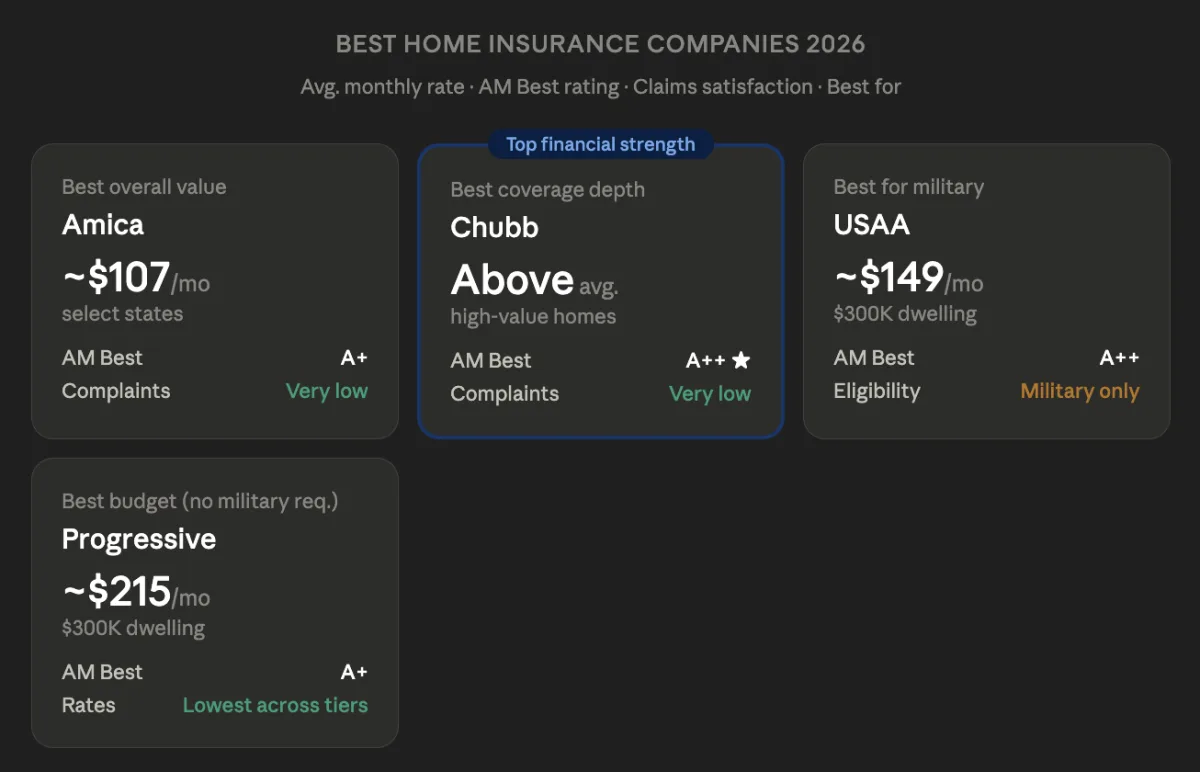
Best overall (value + accessibility): Amica — lowest average premiums among nearly 30 insurers, top-rated by U.S. News and Insure.com.
Best overall (financial strength + coverage depth): Chubb — AM Best A++ (Superior), lowest complaint volume, best for high-value homes.
Best for military families: USAA — restricted to military/veterans, but the most affordable starting rate in multiple analyses.
Best for budget shoppers: Progressive — lowest average rates across three of four dwelling-coverage levels, per Forbes Advisor 2026.
Best for claims handling: Travelers — top-ranked for billing and renewal satisfaction; hasn't withdrawn from California.
TL;DR — What You Need to Know in 60 Seconds
- 71% of homeowners say their insurance costs have risen in 2026, according to a Pew Research Center survey of 3,524 U.S. adults.
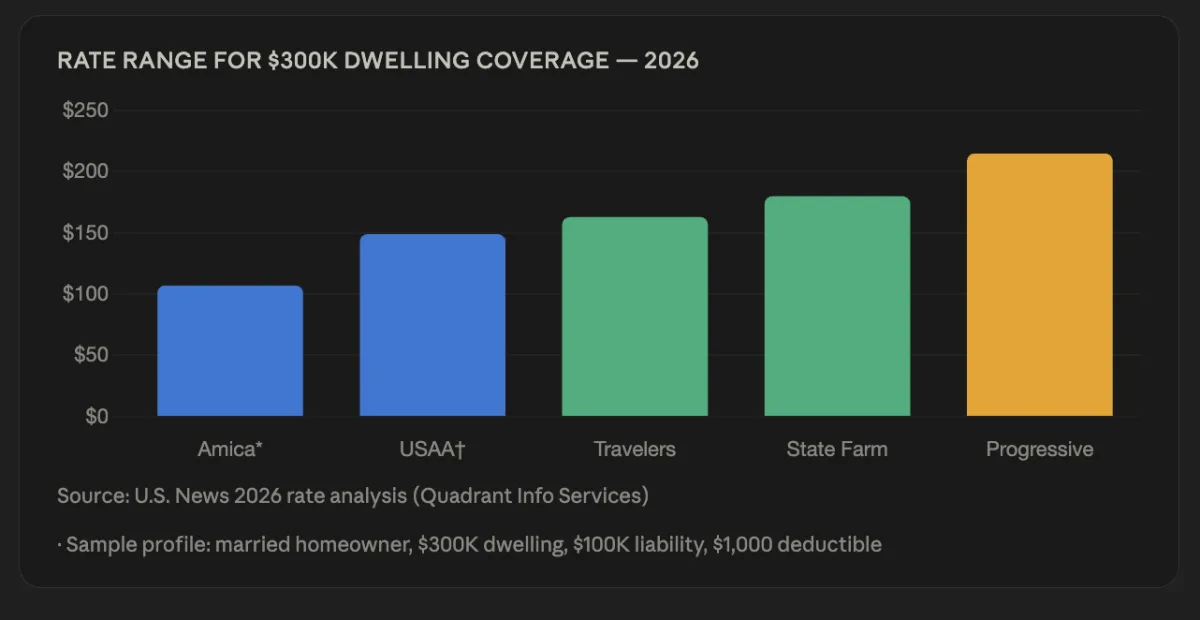
- The national average is roughly $1,424–$1,510/year for a $300,000 dwelling policy; starting rates vary from ~$107/month (Amica, select states) to $215/month (Progressive), per U.S. News rate data.
- The biggest hidden risk isn't price — it's replacement cost vs. actual cash value. Many budget policies default to actual cash value, which deducts for depreciation and often leaves you thousands short on a real claim.
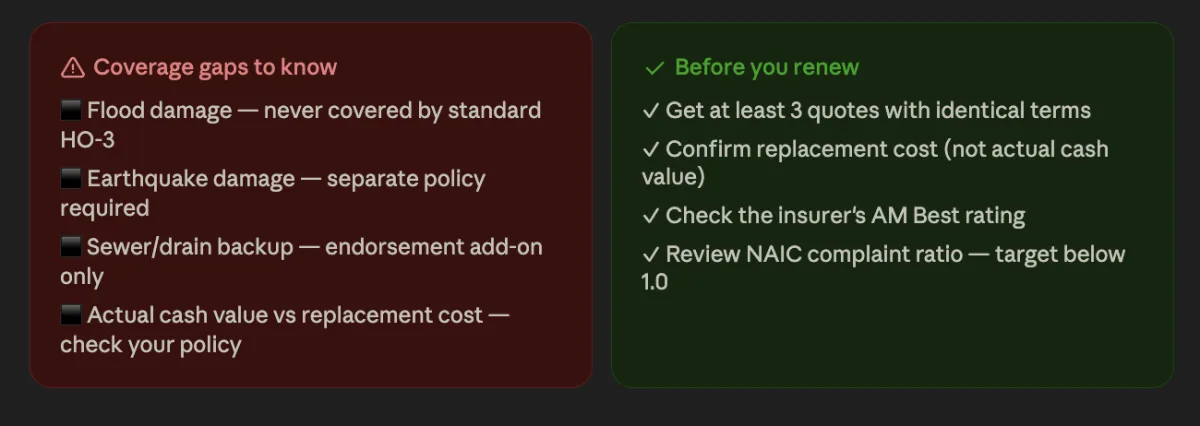
- Flood and earthquake damage are never covered by a standard HO-3 policy. These require separate policies.
- Get at least three quotes with identical coverage terms before renewing. A $100/year premium difference can easily mask a $10,000+ coverage gap.
Why Home Insurance Is Harder to Navigate in 2026
The market has shifted — and not in homeowners' favor.
According to a Pew Research Center survey conducted March 2026 among 3,524 U.S. adults, 71% of homeowners say their home insurance costs have gone up. Of those, 42% say costs have risen "a lot." Upper-income households are hit hardest at 47%. Regionally, the Midwest leads at 73% reporting increases, followed by the South (72%), West (70%), and Northeast (69%).
Climate risk is the primary driver — but there are early signs of stabilization. Swiss Re projects premium growth to slow by 3% following a relatively calm 2025 hurricane season (the first in a decade without a major U.S. landfall). AM Best has revised its homeowners insurance outlook from "Negative" to "Stable" for 2026, per Matic's 2026 Home Insurance Trends Report.
That's genuinely good news. The caveat: a single major catastrophic weather event could reverse those trends quickly. Financial strength still matters as much as current pricing.
If you're thinking about how home insurance fits into your broader financial picture — alongside credit cards, mortgage decisions, and investment accounts — our Financial Services Guide 2026 covers the full landscape.
What a Standard HO-3 Policy Covers (and the Gaps That Cost Homeowners the Most)
A standard HO-3 policy covers six areas:
- Dwelling — the structure of your home
- Other structures — fences, detached garages, sheds
- Personal property — your belongings inside the home
- Loss of use — temporary housing if your home becomes uninhabitable
- Liability — legal protection if someone is injured on your property
- Medical payments to others — minor injuries to guests, regardless of fault
That sounds comprehensive. The exclusions are where things get expensive.
Flood damage and earthquake damage are not covered under any standard policy. These require separate coverage entirely — a fact many homeowners only learn after filing a claim. Water backup from sewers or drains is also typically excluded unless you add a specific endorsement.
The deductible deserves more scrutiny than it usually gets. According to Consumer Reports, which surveyed nearly 24,000 policyholders, a typical deductible is $1,135, with about half of policyholders reporting deductibles between $500 and $2,499. A higher deductible lowers your premium but increases your out-of-pocket cost on every claim.
Replacement cost vs. actual cash value is arguably the most consequential decision in your policy. Replacement cost coverage pays to rebuild or replace at current market prices. Actual cash value deducts for depreciation — a 10-year-old roof that costs $12,000 to replace might net you only $6,000–$7,000 after depreciation is applied. Many budget policies default to actual cash value. That's how homeowners end up severely underinsured without realizing it.
If you're also comparing renters insurance — for a secondary property or a family member renting separately — see our Best Renters Insurance 2026 guide for a parallel breakdown of coverage terms.
How This Guide Was Researched
This guide synthesizes 2026 rankings and rate analyses from five major independent evaluators: U.S. News (which analyzed nearly 30 insurers, evaluated by licensed P&C agent Catriona Kendall and CFP Susannah Snider), NerdWallet (which rated Chubb, NJM, and USAA highest), Yahoo Finance (which named Chubb best overall with a 4.6/5 star rating), Forbes Advisor (which analyzed 39,000+ rates across 14 insurers), and Insure.com (which ranked Amica No. 1 based on consumer surveys). Financial strength ratings from AM Best and complaint data from the NAIC appear across all evaluations.
This site has not personally tested any insurance policy. Our value is in cross-referencing these sources to surface where evaluators agree — and where they diverge meaningfully.
Best Home Insurance Companies of 2026: Top Picks by Category
Rather than a flat ranked list, the most useful comparison is by situation. Different homeowners need different things from a policy.
Best Overall for Value: Amica
With its flexible coverage and positive customer feedback, Amica is the best homeowners insurance provider overall in U.S. News's in-depth analysis of nearly 30 insurers, and it also has the cheapest average premiums. Insure.com independently arrives at the same conclusion: Amica held onto the No. 1 spot for homeowners insurance in 2026 thanks to low rates and a very low complaint ratio with the NAIC. At an average of $1,510 per year, rates are significantly below the national average.
The limitation: Amica operates in fewer states than national carriers, so the rate advantage may not apply everywhere. Get a quote to confirm availability in your state.
Best for: Homeowners prioritizing overall value who want a company with strong claims handling and low complaint volume.
Best Overall for Coverage Depth: Chubb
Chubb's perks and high coverage limits make it a great choice for affluent homeowners. It has far fewer consumer complaints than expected for a company of its size, and standard coverage includes features that many companies offer only as extras.
Chubb scored highest across multiple sections, including financial strength. This is evidenced by a low NAIC complaint index and an AM Best A++ (Superior) Financial Strength Rating. That A++ rating — the highest available — means Chubb has the demonstrated capital reserves to pay out large volumes of claims even after a major regional catastrophe.
The trade-off: most consumers can't get a quote online and need to contact a local agent. Chubb also tends to price toward higher-value homes.
Best for: Homeowners with high-value properties who prioritize coverage depth and financial stability over the lowest possible premium.
Best for Military Families: USAA
USAA is only available to military personnel, eligible relatives, and employees of certain federal agencies. As the best option for military members and veterans, USAA provides special gear coverage for homeowners on active duty or active reserve, as well as other benefits that would normally cost extra with other providers.
USAA home insurance has the cheapest sample rate in U.S. News's study, with average rates for a $300,000 dwelling policy starting around $149/month. USAA consistently offers low home insurance rates across multiple dwelling coverage levels and a very low complaint level.
Best for: Active-duty military, veterans, and their immediate families — no exceptions to eligibility.
Best for Budget Shoppers (No Military Requirement): Progressive
Progressive has the lowest average rates for $200,000, $350,000, and $500,000 dwelling coverage among the insurers in Forbes Advisor's analysis. Progressive also had the second cheapest rate for $750,000 dwelling coverage. That consistency across coverage levels makes it a strong default if price is your primary constraint and you don't qualify for USAA.
Best for: Price-sensitive homeowners who want low rates across multiple coverage levels without military eligibility requirements.
Best for Claims Handling: Travelers
Travelers jumped to the No. 2 spot for 2026 with lower-than-average rates and a low complaint ratio. Customers' high satisfaction rate with policy offerings, combined with the best possible AM Best score, secured Travelers' spot. The survey saw a strong showing for Travelers in billing, where it was top-ranked, and 92% said they plan to renew their coverage.
Notably, Travelers is one of the major carriers that hasn't withdrawn from California — making it worth a quote in markets where availability itself has become a challenge.
Best for: Homeowners who prioritize a smooth, reliable claims process as their top criterion.
Best for High Coverage Limits: Erie Insurance
Yahoo Finance highlights Erie Insurance for homeowners who need above-standard dwelling or liability limits. Erie stands out in Forbes Advisor's evaluation for its low average costs and add-on coverage. The caveat: Erie's rates vary significantly by state, and in some markets — North Carolina, for example — Erie's annual premium reaches $2,337, the highest in that state's analysis (per U.S. News state data). Erie's strength in coverage depth comes with a meaningful price premium in certain regions.
Best for: Homeowners who need higher-than-standard coverage limits and are willing to pay for that depth.
Best for Local Agent Service: State Farm
State Farm has one of the largest agent networks in the country — a genuine differentiator for homeowners who want a consistent local point of contact rather than a call center. State Farm dropped two spots to No. 4 in Insure.com's 2026 ranking; it increased rates and a slightly lower financial stability rating affected its ranking. Still, it remains a top-three pick at U.S. News and posts competitive rates in multiple state-level analyses.
Best for: Homeowners who prefer in-person service and want a dedicated local agent relationship.
Rate Benchmarks: What Does Home Insurance Actually Cost in 2026?
Rate comparisons are only meaningful when the policy terms are identical. Here's what major 2026 analyses found:
| Insurer | Avg. Monthly Rate (est.) | Coverage Level | Source |
|---|---|---|---|
| USAA | ~$149/mo | $300K dwelling | U.S. News |
| Amica | ~$107/mo | Select states only | U.S. News |
| State Farm | ~$180/mo avg | $300K dwelling | U.S. News |
| Progressive | ~$215/mo | $300K dwelling | U.S. News |
| Amica (annual) | $1,510/yr | National avg | Insure.com |
| Travelers (NC) | $1,958/yr | State analysis | U.S. News NC |
| Erie (NC) | $2,337/yr | State analysis | U.S. News NC |
The national average sits at roughly $1,424–$1,510 per year for a standard $300,000 dwelling policy, depending on the source and methodology.
The state factor is critical. A company with competitive national averages may be priced very differently in your specific state. Average rates from the largest home insurers can vary by more than $1,000 a year, according to NerdWallet's most recent rates analysis. Always get state-specific quotes rather than relying on national benchmarks.
Nationwide runs a program called Ting, which monitors home electrical systems to detect fire risks before they cause damage — a small investment by the insurer aimed at reducing claim frequency and, over time, supporting rate stability for policyholders.
Claims Satisfaction and Financial Strength: The Metrics That Actually Matter

A low premium means very little if your claim is denied, delayed, or settled far below your actual loss.
J.D. Power's 2026 Home Insurance Study ranks insurers on trust, price for coverage, and claims handling. Allstate scores below the industry average on the J.D. Power study despite offering competitive rates — a trade-off worth considering explicitly.
NAIC complaint ratios provide a separate signal. A ratio above 1.0 means more complaints than expected for an insurer's size; below 1.0 means fewer. Both U.S. News and Yahoo Finance incorporate NAIC data specifically because it reflects real policyholder experiences, not marketing claims. Amica and Chubb consistently post well below 1.0 across multiple evaluations.
AM Best financial strength ratings matter most during catastrophic events. An insurer rated A++ (Superior) — like Chubb and Travelers — has demonstrated capital reserves to pay large volumes of simultaneous claims. That distinction only becomes visible after a major regional disaster, which is precisely when it matters most.
For a broader picture of how financial product ratings and financial strength work across insurance, investing, and lending, our Financial Services Guide 2026 explains the key third-party rating systems in one place.
How to Choose the Right Home Insurance Company for Your Situation
Here's a practical decision framework based on the 2026 evaluations:
If you're active military or a veteran: Start with USAA. Its rates, coverage depth, and customer satisfaction consistently rank at or near the top across every major evaluation — and its eligibility restrictions are firm.
If you want the best overall value without military eligibility: Compare Amica (best overall at U.S. News and Insure.com) and Progressive (lowest rates across most dwelling-coverage levels at Forbes). Amica wins on customer satisfaction; Progressive wins on price.
If you have a high-value home: Prioritize Chubb for AM Best A++ strength and coverage depth, or Erie for above-standard limits. Both require you to compare policy terms carefully against a standard policy before committing.
If you want the smoothest claims experience: Travelers leads on claims satisfaction and billing in the most recent Insure.com consumer survey, with a 92% renewal rate.
If you prefer in-person service: State Farm's agent network is unmatched in size. Rates are competitive and the company is available nationally.
If you want maximum endorsement flexibility: American Family Insurance offers among the broadest range of optional coverage add-ons, useful if your standard HO-3 doesn't cover specific assets or risks.
Regardless of which company you choose: get at least three quotes with identical coverage terms before deciding. Compare dwelling limits, deductibles, personal property coverage type (replacement cost vs. actual cash value), and key exclusions. A $100 annual premium difference is not worth a $10,000 gap in coverage when you actually file a claim.
Frequently Asked Questions
What is the best home insurance company in 2026?
It depends on the criteria. U.S. News and Insure.com both name Amica best overall for its low rates, flexible coverage, and low NAIC complaint volume. NerdWallet and Yahoo Finance name Chubb best overall for financial strength (AM Best A++) and coverage depth. USAA ranks best for military families across every major evaluation. The right answer depends on your home value, location, and what you prioritize — price, coverage, or claims experience.
How much does home insurance cost in 2026?
The national average is roughly $1,424–$1,510 per year for a $300,000 dwelling policy, depending on the analysis. U.S. News found average monthly rates ranging from about $149/month (USAA) to $215/month (Progressive) for that coverage level. State-level rates vary significantly — in North Carolina alone, annual premiums range from under $1,000 (State Farm) to $2,337 (Erie) for comparable coverage.
Is USAA home insurance available to everyone?
No. USAA coverage is exclusively available to active-duty military, veterans, and their immediate families. For everyone else, Progressive is the most widely accessible low-cost option based on Forbes Advisor's 2026 rate analysis.
What does a standard home insurance policy not cover?
Standard HO-3 policies exclude flood damage, earthquake damage, and sewer/drain backup (unless added as an endorsement). Flood insurance requires a separate policy, often through the National Flood Insurance Program (NFIP). If your home is in a designated flood zone, your mortgage lender may require it.
What is the difference between replacement cost and actual cash value?
Replacement cost pays to rebuild or replace at current market prices with no depreciation deducted. Actual cash value deducts for depreciation — a 10-year-old roof or appliance will be worth significantly less under actual cash value, which can leave you thousands short on a real claim. Replacement cost coverage costs more in premiums but provides substantially better protection when you need it.
Why did my home insurance premium go up in 2026?
According to Pew Research Center's March 2026 survey of 3,524 U.S. adults, 71% of homeowners report their costs have increased. The primary drivers are climate risk, rising construction costs, and increased claims frequency. AM Best revised its outlook to "Stable," and Swiss Re projects premium growth to slow — but rates are not expected to reverse meaningfully in the near term.
How many home insurance quotes should I get?
Most independent insurance experts and consumer advocates recommend at least three quotes with identical coverage terms. Comparing only monthly premiums without comparing dwelling limits, deductibles, and coverage type (replacement cost vs. actual cash value) leads to false savings that only becomes apparent when you file a claim.
Before You Go: Related Financial Guides
If you're making broader financial decisions alongside your insurance review, these guides on Grounded Pick cover connected topics:
- Making your first home purchase? Our Best Mortgage Lenders 2026 guide covers lenders by rate, loan type, and first-time buyer support.
- Renting instead of owning? See our Best Renters Insurance 2026 guide for coverage and rate comparisons.
- Evaluating life insurance at the same time? Our Best Life Insurance Companies 2026 guide compares term vs. whole life across major carriers.
- Reviewing your overall financial product mix? The Financial Services Guide 2026 covers insurance, credit, and investing in one framework.
Reviewed by the Grounded Pick editorial team. This article was drafted with AI assistance and fact-checked by a human before publishing. Our editorial recommendations are finalized before any affiliate link is applied and are never influenced by commercial relationships. Read our editorial standards →
Discussion
No comments yet. Be the first to share your thoughts.