
How this guide was researched: We aggregated data from Queue-it's 2026 loyalty statistics report, LoyaltyLion's 2026 program analysis, Open Loyalty's 2026 Trends Report, Plant-A Insights Group / USA TODAY 2026 ranking (19,000+ respondents), Rivo's 2026 tiered loyalty statistics, The Points Guy April 2026 valuations, U.S. News 2025–2026 travel rewards rankings, WalletHub, NerdWallet, AwardFares, and arrivia's travel loyalty research. We did not personally test these programs. We may earn a commission from purchases made through links on this page. Drafted with AI assistance, fact-checked editorially. How we review →
Quick Answer: Which Rewards Programs Are Worth Your Time in 2026?
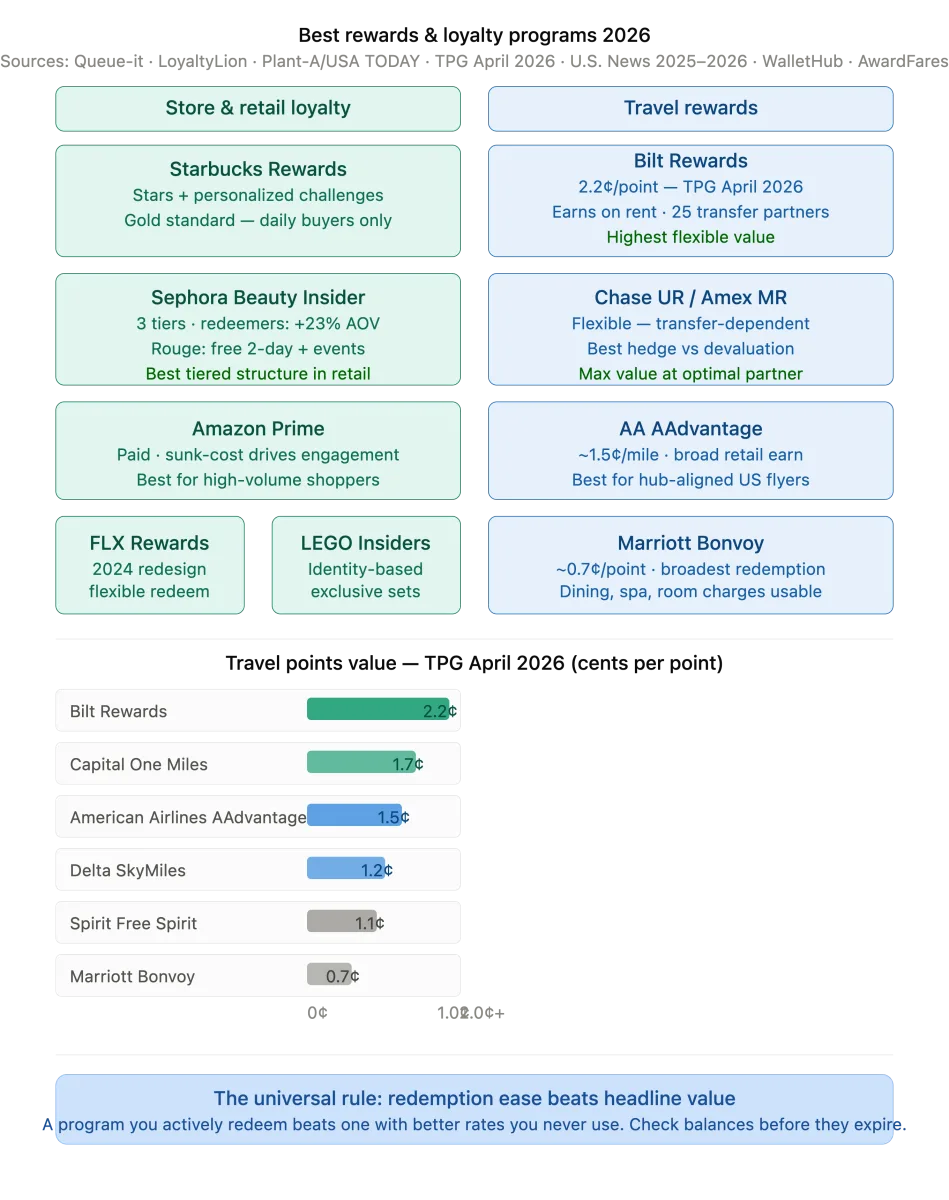
Store & retail loyalty — top picks:
- Starbucks Rewards — best for daily coffee buyers who use the app; personalized challenges, instant earn-and-redeem loop
- Sephora Beauty Insider — best tiered program in retail; VIB/Rouge tiers deliver meaningfully better benefits than base Insider
- Amazon Prime — best paid loyalty benchmark; value depends entirely on how often you shop and use Prime Video
- Foot Locker FLX — best redesigned program; 2024 overhaul fixed its core flaw (points now redeemable without raffle)
- LEGO Insiders / lululemon Sweat Collective — best niche programs; genuine value for enthusiasts and fitness professionals
Travel rewards — top picks:
- Bilt Rewards — highest per-point value at 2.2¢ per TPG's April 2026 valuations; earns on rent, now has 25 transfer partners
- Chase Ultimate Rewards / Amex Membership Rewards — best flexible transferable currencies; hedge against any single program devaluing
- American Airlines AAdvantage — best US airline program for hub-aligned travelers; broad retail/dining earning ecosystem
- Marriott Bonvoy — best hotel loyalty structure; redemption breadth (dining, spa, room charges) makes points feel usable year-round
- Flying Blue (Air France/KLM) — best transatlantic redemption value; monthly promo awards add upside
The universal principle: A rewards program you actively redeem delivers more value than a program with better headline rates you never use. Redemption ease is the single most important factor in both categories.
Part 1 — Store & Retail Loyalty Programs
The Saturation Problem: Why 90%+ of Companies Have Loyalty Programs
You're at checkout. The cashier asks if you have a rewards card. You dig through your wallet, can't find it, give up. Most people are enrolled in far more loyalty programs than they actively use — and the gap between being a member and extracting real value is wider than retailers want to admit.
According to Queue-it's 2026 loyalty statistics report, more than 90% of companies now offer some form of loyalty program. That saturation makes differentiation critical — for retailers trying to stand out, and for consumers deciding where to concentrate their spending.
The Plant-A Insights Group and USA TODAY 2026 ranking evaluated more than 2,000 loyalty and rewards programs in the US before selecting 350 highest-scoring programs based on a large-scale consumer sentiment survey of 19,000+ respondents. The programs below consistently appear in that top tier — but their value to you depends on your specific shopping behavior, not their brand recognition alone.
What Makes a Store Loyalty Program Worth It: The Six Criteria
LoyaltyLion's 2026 analysis identifies six characteristics shared by programs that consistently outperform:
- Clear, valuable rewards — the reward must be something you actually want, not just a discount on a future purchase you may not make
- Simplicity of use — programs requiring complex tracking or confusing point conversion rates lose members quickly
- Fast gratification — per Open Loyalty's 2026 Trends Report, 75% of businesses are prioritizing real-time rewards; instant delivery is now a baseline expectation
- Personalization — programs that use purchase history to tailor offers outperform generic broadcast promotions significantly
- Emotional connection — the strongest programs make members feel part of a community, not just a transaction
- Cross-channel integration — rewards should be earnable and redeemable whether you shop in-store, online, or via app
Open Loyalty's report also found that 81% of consumers show interest in visual progress bars as a loyalty feature. People want to see where they stand and how close they are to the next reward. Programs that make progress visible retain members more effectively than those that don't.
Top Store Loyalty Programs Compared
| Program | Structure | Reward speed | Personalization | Best for |
|---|---|---|---|---|
| Starbucks Rewards | Points (Stars) + challenges | Instant | High — app-driven offers | Daily coffee buyers |
| Sephora Beauty Insider | Three-tier (Insider/VIB/Rouge) | Fast | High — purchase-based | Regular beauty shoppers |
| Amazon Prime | Paid flat membership | Immediate (shipping) | Medium — browsing-based | Frequent cross-category buyers |
| LEGO Insiders | Points + community | Moderate | Medium | Brand enthusiasts |
| Foot Locker FLX Rewards | Points (redesigned 2024) | Fast | Medium | Sneaker buyers |
| lululemon Sweat Collective | Community/identity-based | Ongoing access | Low (niche) | Fitness professionals |
Starbucks Rewards: Why It Remains the Gold Standard
Starbucks Rewards earns its reputation not through generous reward ratios but through frictionless execution. You order through the app, pay through the app, earn Stars through the app, redeem through the app. There is no card to carry, no cashier to remind, and no separate redemption step. The entire loop closes in a single interaction.
As Yotpo's 2026 analysis notes, Starbucks has successfully made its loyalty program a core part of the buying process — and uses the data it collects to send personalized offers based on order history. If you regularly order cold brew, your challenges will be tied to cold brew purchases, not generic promotions for items you've never bought.
The honest limitation: Stars expire after six months of inactivity, and the program heavily favors frequency. A once-a-week Starbucks customer still gets value, but the streak bonuses and personalized challenges are designed for daily visitors. Happy Rewards cites Bain & Company data showing a 5% increase in customer retention can boost profits by 25–95%, and McKinsey data showing top-performing loyalty programs drive 15–25% higher annual revenue from members. Starbucks Rewards is a primary driver of both outcomes.
Best for: Daily or near-daily coffee buyers who use the app. Not ideal for: Occasional visitors or those who prefer ordering in-person.
Sephora Beauty Insider: The Tiered Model Done Right
Most tiered loyalty programs fail at the same point: the gap between tiers is either too large to feel achievable or too small to feel meaningful. Sephora's Beauty Insider avoids both traps. Its three tiers — Insider (free), VIB (unlocked at a defined annual spend threshold), and Rouge (unlocked at $1,000 annual spend) — each deliver meaningfully better benefits, not marginally better ones.
Rouge members unlock free two-day shipping, exclusive product access, and invitation-only events. Those experiential rewards cannot be replicated by a competitor offering a slightly higher discount. They create loyalty that is genuinely harder to defect from. Yotpo's analysis describes it as a tiered system done right precisely because the aspiration to advance is always visible and credible.
Rivo's 2026 tiered loyalty statistics (citing ResearchGate) shows that loyalty redeemers have 23% higher average order value than non-redeemers. Sephora's tier structure converts passive members into active redeemers by making each tier's benefits concrete and immediately useful.
Honest limitation: casual beauty shoppers who split spending across Sephora, Ulta, and drugstore brands may never leave the Insider tier, where base benefits are underwhelming. This program rewards consolidation. If you're willing to consolidate your beauty spending at Sephora, it rewards you well.
Underrated Programs Worth Knowing
LEGO Insiders rewards purchases with points redeemable for exclusive sets and early product access. But the program's real strength is identity. LEGO buyers are enthusiasts who identify strongly with the brand — exclusive set redemptions available only within the program create genuine perceived value that a points-for-discounts system cannot replicate.
lululemon Sweat Collective, as Queue-it's 2026 analysis describes it, targets yoga teachers, coaches, and personal trainers — visible members of the fitness community who wear lululemon gear where others see it. The underlying logic is community identity, not transaction volume. Genuine value for fitness professionals; not available to general consumers.
Foot Locker FLX Rewards is worth knowing because it illustrates what happens when a structural flaw undermines an otherwise functional program. In its original version, members could only use points for raffle entries to buy limited sneakers. Members who didn't win those raffles felt their points were simply wasted. Foot Locker's 2024 redesign — built on direct customer research — introduced flexible point spending that gives every member a guaranteed path to redemption. The lesson for any loyalty program evaluation: a program that makes members feel their loyalty is wasted will lose them regardless of how attractive the headline rewards appear.
The Real Numbers: What Store Loyalty Programs Deliver
LoyaltyLion's 2026 research documents that loyalty programs led to a 39% increase in average customer lifetime value and 36% increase in average spend across analyzed programs. From LoyaltyLion's benefits analysis, Harvard Business Review data shows loyalty program members spend 13–20% more over time than non-members. Repeat customers spend 67% more than new ones, and members who redeem rewards spend up to 25% more per year than those who don't redeem.
The critical implication: a program membership you never use delivers nothing. Rivo's statistics confirm that redeemers have 23% higher average order value than non-redeemers. Redemption is where value materializes.
Deloitte consumer survey data, cited by Happy Rewards, found that 72% of consumers say loyalty program membership influences their purchasing decisions. That influence is bidirectional: it drives members toward enrolled brands and implicitly away from non-enrolled competitors. The strategic implication — enroll where you already spend consistently, not everywhere you could theoretically earn.
Tiered vs. Points-Based vs. Paid: Which Structure Suits Your Shopping?
The three dominant loyalty structures suit different shopping profiles. Knowing which type matches your behavior is more useful than chasing the highest headline reward rate.
Points-based programs are the most common and easiest to understand. Open Loyalty's 2026 Trends Report notes these are moving away from traditional structures that are becoming less effective as members grow accustomed to them and expect more. Still work well for occasional shoppers who want simplicity; rarely create the emotional engagement that drives long-term loyalty.
Tiered programs create stronger long-term engagement because the aspiration to reach a higher tier motivates sustained spending. Sephora Beauty Insider is the clearest positive example. Disadvantage: low-frequency shoppers may never leave the base tier where benefits are underwhelming.
Paid programs (Amazon Prime) create a sunk-cost effect that motivates engagement — members who pay for the program use it more to justify the expense. Highest per-member value for high-frequency users; lowest value for infrequent ones.
Hybrid programs combining all three are the most effective in 2026. Starbucks Rewards uses points as a base layer, adds personalized challenges that function like a tier system, and integrates gamification through streaks and progress tracking. Open Loyalty's data confirms gamification and experience-based rewards are now core parts of modern loyalty programs, not add-ons. The 81% consumer interest in visual progress bars is the clearest signal of this shift.
Red Flags: Signs a Store Loyalty Program Isn't Worth Joining
Not every loyalty program is designed to reward you. Some are primarily data collection mechanisms with a thin layer of rewards on top. Warning signs:
- Points that expire quickly or without clear notice — programs structured to reduce redemption, not enable it
- Rewards redeemable only on future purchases above a minimum threshold — a discount mechanism disguised as a reward, benefiting the retailer more than the member
- No clear points-to-value conversion — if you can't calculate what your points are worth in dollars, the program is deliberately obscuring its value proposition
- Rewards catalog filled with low-value items — impressive point totals that only redeem for branded merchandise or sweepstakes entries
- Enrollment requiring extensive personal data for minimal benefit — extracting more value than it gives
- No app integration or cross-channel earning — structurally outdated in 2026
- Tier resets that eliminate progress annually — read the reset policy before investing in tier progression
Part 2 — Travel Rewards Programs
The Right Question to Ask About Travel Points
You're sitting on 47,000 American Airlines miles, 23,000 Marriott Bonvoy points, and a Chase Sapphire account you opened two years ago. You want to book a trip this fall, but you're not sure which balance to tap first — or whether any of them are worth what you think they are. This is the situation most travelers find themselves in. The question isn't which program has the flashiest sign-up bonus. It's which points hold real redemption value in 2026 and which ones are quietly losing ground.
Head-to-Head: Which Travel Points Are Worth the Most?
The most direct way to compare loyalty currencies is cents per point — how much real dollar value you extract from each point or mile when you redeem it. According to The Points Guy's April 2026 monthly valuations:
| Program | Type | TPG April 2026 value (cents/point) |
|---|---|---|
| Bilt Rewards | Flexible transferable | 2.2¢ |
| Amex Membership Rewards | Flexible transferable | Transfer-dependent (high ceiling) |
| Chase Ultimate Rewards | Flexible transferable | Transfer-dependent (high ceiling) |
| Capital One Miles | Flexible transferable | ~1.7¢ |
| American Airlines AAdvantage | Airline miles | ~1.5¢ |
| Delta SkyMiles | Airline miles | ~1.2¢ |
| Marriott Bonvoy | Hotel points | ~0.7¢ |
| Spirit Airlines Free Spirit | Airline miles | 1.1¢ |
The gap between Bilt at 2.2¢ and Marriott Bonvoy at ~0.7¢ is not trivial. On a 50,000-point balance, that difference translates to $1,100 vs. $350 in value — same number of points, dramatically different purchasing power depending on where they sit.
TPG's valuations represent median redemption value, not best-case scenarios, so they reflect what a reasonably informed traveler can realistically expect. Flexible transferable currencies consistently outperform single-program currencies, and the reason is structural: when you hold Bilt points, you can move them to 25 transfer partners and redeem at whichever offers the best value for your specific itinerary. A Spirit mile can only be used within Spirit's network, which caps the ceiling on value.
The Citi Strata Premier card illustrates how transfer flexibility amplifies sign-up bonus value. According to CreditCards.com, the card offers 60,000 ThankYou Points after meeting a spending threshold in the first three months. At a baseline of 1¢ per point, that bonus is worth $600. But transferring to the right high-value partner can push the per-point value to an estimated 1.9¢ — making the same 60,000-point bonus worth approximately $1,140. The points didn't change; the destination did.
NerdWallet applies a similar methodology, setting credit card point values based on the highest-value transfer partner available for each program.
How Travel Rewards Rankings Are Built: Understanding the Methodology

Not all rankings measure the same thing. Understanding the methodology behind each helps you apply the right lens to your own situation.
U.S. News & World Report released its 2025–2026 Best Travel Rewards Programs rankings evaluating programs across two categories: airline frequent flyer programs and hotel loyalty programs. Their methodology weighs membership benefits, network coverage, ease of earning and redeeming, hotel property diversity, and airline quality.
WalletHub takes a more quantitative approach. Its Rewards Value metric is calculated from three components: Amount Spent, Miles Earned, and Redemption Value. In plain terms — spend X dollars, earn Y miles, redeem for Z dollars in airfare. Programs that require heavy spending to reach a useful balance, or that offer poor award availability, score lower regardless of marketing claims. WalletHub collected airline ticket cost data in March 2026 and notes it is likely to have changed since — an honest acknowledgment of how quickly redemption values shift.
Plant-A Insights Group surveyed more than 19,000 respondents between September and October 2025 across five dimensions of customer satisfaction. Their methodology also excluded companies involved in consumer data protection incidents within the past two years — a filter that reflects growing consumer concern about data privacy in loyalty ecosystems.
Practical use: use U.S. News rankings for a structural assessment of program quality, WalletHub to model earning math against your actual spending, and TPG's monthly valuations to know what your existing balance is worth right now.
Flexible Points vs. Airline Miles vs. Hotel Points: Which Category Wins?

The category of currency you hold often matters more than the specific program within that category.
Flexible transferable currencies — American Express Membership Rewards, Chase Ultimate Rewards, Capital One Miles, and Bilt Points — function as a hedge against program devaluation. When one airline partner raises its award prices or removes a route, you move your points to a different partner. AwardFares identifies these four programs as "your best hedge" and notes that earning points through flying alone is slow — co-branded credit cards and sign-up bonuses are the primary accelerators of balance growth.
Airline miles work best for travelers with a clear home airport and a preferred carrier. If you fly out of Dallas and predominantly use American Airlines, AAdvantage miles have obvious utility. The problem arises when programs shift to dynamic pricing for award redemptions, which removes predictability. When you can no longer calculate in advance how many miles a specific flight will cost, planning becomes guesswork.
Hotel points typically carry lower per-point valuations than airline miles, but redemption frequency is higher. A traveler is more likely to use hotel points on a weekend stay than to accumulate enough airline miles for a transatlantic business class seat. Marriott Bonvoy's model — where points are usable for dining, spa services, and room charges in addition to free nights — is specifically designed to make redemptions feel frequent and practical.
AwardFares makes a point worth repeating: "No single best program — the ideal program for you depends on your home airport, typical destinations, and travel style." A solo traveler chasing premium cabin upgrades has a completely different optimization problem than a family of four booking economy seats.
One practical risk: spreading spending across too many programs dilutes every balance below a useful redemption threshold. Concentrating on one or two programs — ideally one flexible currency and one program tied to your most-used airline or hotel brand — typically delivers more usable value than collecting small balances across six programs.
Top Airline Programs: Earning Speed and Redemption Reality
American Airlines AAdvantage holds a top position in U.S. News' 2025–2026 rankings, recognized for its co-branded credit card ecosystem and earning velocity. AAdvantage members earn miles through flights, co-branded card spending, and a broad network of retail and dining partners — which means the program rewards members even when they're not flying.
The SkyTeam alliance programs represent a strong alternative for travelers with transatlantic routes as a priority. AwardFares highlights Flying Blue (Air France/KLM), Delta SkyMiles, SAS EuroBonus, and Virgin Atlantic Flying Club as notable programs within SkyTeam's 18-member network. Flying Blue in particular has developed a reputation for competitive redemption rates on transatlantic routes, with monthly promo awards offering discounted mileage rates on specific routes for flexible travelers.
The honest limitation of airline miles in 2026: the ongoing shift toward dynamic pricing makes it harder to know in advance what a mile is worth. WalletHub's scoring framework penalizes programs with poor award availability or high redemption thresholds — a program that scores well on earning but poorly on redemption doesn't rank highly, and that's the right call.
Hub airport alignment remains the most practical filter. If your home airport is a Delta hub, SkyMiles will likely deliver more usable value than AAdvantage simply because more of your flights will earn and redeem within that network.
Top Hotel Programs: When Points Feel Practical
Marriott Bonvoy is consistently recognized as a top hotel program in U.S. News' rankings. Its redemption breadth is the distinguishing feature — members can use points not only for free nights but for on-property dining, spa services, and room charges, with additional savings through PointSavers (a dynamic pricing tool offering discounted point rates on select properties and dates).
Consumer data supports this design. According to arrivia's travel loyalty research, 26% of consumers who travel seven or more times per year already use loyalty points to fund their trips, and 56% say additional opportunities to earn points would influence their booking decisions. Programs that make points feel usable in everyday travel moments — not just once-a-year redemptions — capture more of that behavioral loyalty.
U.S. News evaluates hotel programs on property diversity, which matters more than it might seem. A program with a portfolio across budget, mid-range, and luxury tiers allows members to redeem points on the trips they actually take, not just aspirational stays at five-star properties.
Practical limitation: hotel points accumulate slowly for infrequent travelers without a co-branded hotel credit card. Reaching a free night threshold at a mid-tier property can take two to three years of organic earning. A co-branded credit card changes that math significantly — but the annual fee cost should be factored into the true value calculation.
The Hidden Variable: Earning Speed Changes Everything
Most travelers focus on cents-per-point valuations and overlook earning velocity — but the speed at which you accumulate a useful balance is often the more important variable. A point worth 1.5¢ that takes three years to accumulate in useful quantity is less practically valuable than a point worth 1.2¢ you can earn to a useful threshold in six months.
Co-branded credit card sign-up bonuses are the single fastest way to build a meaningful balance. AwardFares describes credit cards as "accelerators" compared to the slow pace of earning through flights alone. The Citi Strata Premier's 60,000-point bonus — worth an estimated $1,140 at optimal transfer partner value per Bankrate valuations cited by CreditCards.com — is equivalent to what many travelers would earn through flights over multiple years.
WalletHub's Rewards Value scoring captures earning velocity by combining Amount Spent, Miles Earned, and Redemption Value into a single metric. Programs that require high spending to earn meaningful miles — or that offer low earn rates on everyday categories — score lower even if their per-mile redemption value is competitive.
Everyday spending categories matter more than flight earnings for most travelers. Programs with broad retail and dining earning partners — like AAdvantage's shopping and dining portals — allow balance growth without changing spending habits. If your grocery store, streaming services, and restaurants all earn miles through the program's ecosystem, the balance grows passively. That passive earning is what makes a program genuinely useful for the majority of travelers who don't fly every week.
Universal Decision Framework: Store + Travel
Four Questions to Evaluate Any Rewards Program
Whether you're looking at a coffee shop loyalty card or a premium travel credit card, these four questions determine whether a program is worth your time:
- Do I already spend here (or fly this airline / stay at this hotel) regularly? Loyalty programs reward existing behavior. Changing your spending behavior to chase points is almost never worth it unless the incremental value is dramatic and measurable.
- Can I realistically reach a meaningful redemption threshold? A program whose redemption threshold requires 18 months of normal spending to reach delivers value in theory but not in practice. Calculate your expected annual earning based on your actual behavior, not the program's advertised earn rate.
- Are the redemption options things I would genuinely use? A program offering exclusive concert tickets as its top reward is worthless to someone who doesn't attend concerts. A points-to-cash option that delivers 0.5¢ per point is worse than just getting a credit card with flat 1.5% cash back. Match the redemption catalog to your actual life.
- Is the program transparent about how points convert to value? If you can't calculate what your accumulated points are worth in dollars within two minutes of looking at the program's terms, the program is deliberately obscuring its value proposition. Transparent programs publish conversion rates clearly.
The Consolidated Decision Guide
| Your profile | Best store program | Best travel program | Strategy |
|---|---|---|---|
| Daily coffee buyer | Starbucks Rewards | — | Use the app; never skip challenges |
| Regular beauty shopper | Sephora Beauty Insider | — | Consolidate at Sephora to reach VIB/Rouge |
| Frequent Amazon shopper | Amazon Prime | — | Justify the fee with video + shipping |
| Sneaker enthusiast | Foot Locker FLX | — | Redeem points flexibly, not just for raffles |
| Frequent US flyer (hub airline) | — | AAdvantage / SkyMiles (hub-dependent) | Co-branded card to accelerate earning |
| Flexible traveler, multiple airlines | — | Bilt / Chase UR / Amex MR | One flexible currency + transfer strategically |
| Hotel traveler (3+ nights/month) | — | Marriott Bonvoy | On-property redemptions maximize usability |
| Occasional traveler, want simplicity | — | Single flexible currency + sign-up bonus | Build balance fast; redeem before devaluation |
Redemption First: The One Rule That Overrides Everything
LoyaltyLion's benefits analysis is direct: members who redeem rewards spend up to 25% more per year than those who don't redeem. The Harvard Business Review data they cite shows loyalty members spend 13–20% more over time than non-members. But both outcomes depend on the same precondition — you have to actually redeem. A program membership that sits dormant delivers no value to you.
Before checking current cents-per-point valuations, check your current balances and when they expire. If you have 30,000 Delta SkyMiles expiring in six months and no upcoming Delta flights, the highest-value action isn't researching which airline program is best — it's finding a redemption that uses those miles before they disappear.
For travel rewards specifically: check TPG's monthly valuations or NerdWallet's points valuations before any redemption. Redemption values shift — a program worth 1.5¢ per point when you enrolled may have changed. Spend your lowest-value currencies first and protect your highest-value balances for premium redemptions.
Frequently Asked Questions
Are free store loyalty programs worth joining even if I shop infrequently? Generally yes, with one condition: only join where you already shop consistently enough to reach redemption. Free enrollment costs nothing, but managing dormant memberships adds mental overhead. If you visit a store fewer than six times a year, the program is unlikely to deliver meaningful value before points expire.
Which travel rewards points are worth the most per point in 2026? Per TPG's April 2026 monthly valuations, Bilt Rewards points lead at 2.2¢ per point among flexible currencies. Flexible transferable currencies from American Express, Chase, and Capital One also rank highly because they can be moved to multiple airline and hotel partners, allowing optimization per trip.
Is Amazon Prime a loyalty program or a subscription service? It functions as both. The upfront annual fee creates the behavioral dynamics of a paid loyalty program — members use Amazon more to justify the cost — while the benefits (free shipping, streaming, early access deals) operate like a traditional rewards structure. Yotpo's 2026 analysis classifies it as the benchmark for paid loyalty programs precisely because it blurs that line effectively.
Is it better to concentrate points in one travel program or spread across several? Concentration is generally more effective. Spreading spending across multiple programs results in balances too small to redeem meaningfully. Focusing on one flexible transferable currency and one program tied to your most-used airline or hotel brand typically delivers more usable value than maintaining small balances across six programs.
How do sign-up bonuses affect the real value of a travel loyalty program? Sign-up bonuses are the fastest way to build a meaningful balance and often represent more value than years of earning through flights alone. The Citi Strata Premier's 60,000-point bonus is worth an estimated $1,140 at optimal transfer partner value — a figure most travelers would take multiple years to accumulate through organic flight earning.
What's the single most important factor in choosing any loyalty program? Redemption ease. A program with modest rewards that you actually redeem delivers more real-world value than one with impressive headline benefits you never use. Before enrolling in any program, check how points are redeemed, whether there are minimum thresholds, and whether the redemption options match things you would genuinely want.
What is dynamic pricing in award redemptions, and why does it matter? Dynamic pricing means miles or points required for a redemption fluctuate based on demand, similar to cash ticket prices. Programs that have moved to dynamic pricing make it harder to predict in advance what a mile is worth, which complicates planning. Programs that retain published award charts or partner-based pricing offer more predictability and are generally easier to maximize.
We may earn a commission from purchases made through links on this page, at no extra cost to you. Full disclosure →
Discussion
No comments yet. Be the first to share your thoughts.