
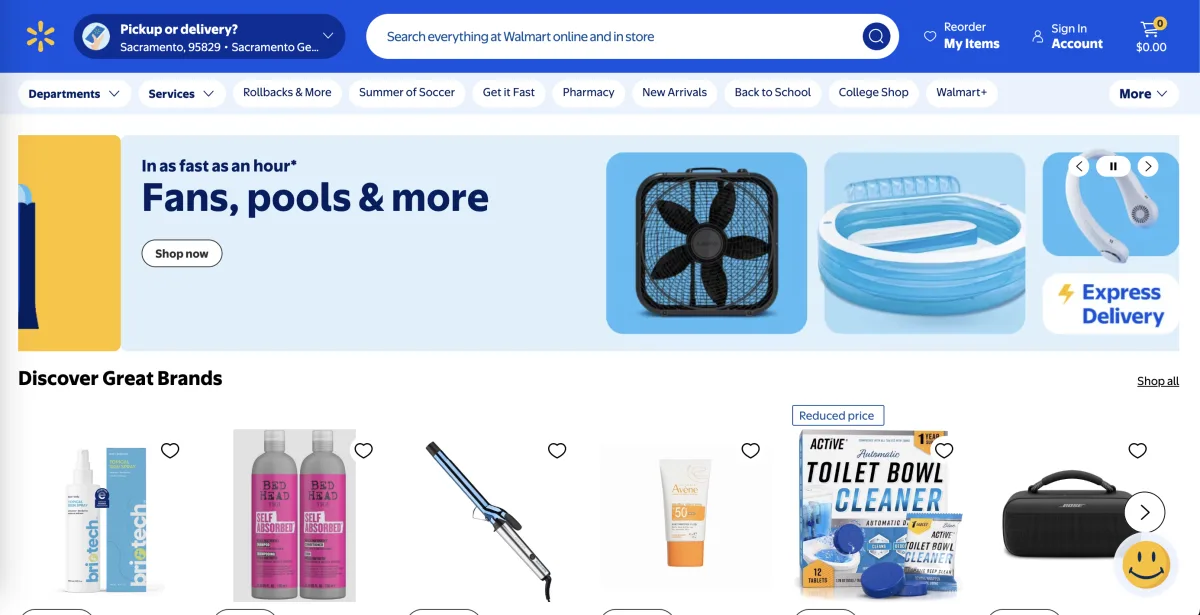
Verdict up front: Walmart.com in 2026 is a legitimately strong option for grocery pickup, competitive on commodity electronics pricing, and a viable Amazon supplement for most US households — but it still has real gaps in marketplace seller quality and rural delivery coverage. Here's what the data actually shows.
Reviewed by the Grounded Pick editorial team. This article was drafted with AI assistance and fact-checked before publishing. We may earn a commission when you use our links. Full disclosure →
Quick Facts
| Category | Rating | Standout Feature |
|---|---|---|
| Grocery Pickup | ★★★★☆ | Store-as-hub model, free with Walmart+ |
| Grocery Delivery | ★★★☆☆ | Reliable in suburban markets; varies elsewhere |
| Electronics | ★★★½☆ | Competitive pricing, marketplace complexity |
| Shipping Speed | ★★★★☆ | Free 2-day on eligible items without membership |
| Walmart+ Value | ★★★★☆ | Strong for frequent delivery users |
| Marketplace Quality | ★★★☆☆ | 160,000+ sellers, variable seller quality |
The Misconception Most Shoppers Still Have About Walmart Online
Most people still picture Walmart.com as a stripped-down Amazon — fewer sellers, clunkier interface, a website that mainly exists to push you into stores. That picture is about two years out of date.
Walmart's online operation in 2026 is a structurally different platform than it was in 2023 or 2024. Total revenues hit $680.9 billion in fiscal year 2026, a 5.1% increase on a constant currency basis, with global e-commerce growing 24% to $100.4 billion. Those are not incremental numbers. They signal a real infrastructure shift — and one that directly affects what you experience when you shop Walmart.com.
The better question isn't "is Walmart online good?" It's: has it improved enough in 2026 to replace or meaningfully supplement your current Amazon, Instacart, and in-store mix? This review answers that using Walmart's own annual report, third-party analyst data, and documented behavioral research.
If you're building a broader US shopping strategy, the US Shopping Money-Saving Guide 2026 covers how to stack platforms — including when Walmart beats Amazon on price — and where each retailer has a structural edge.
What Has Actually Changed at Walmart.com in 2026
The headline shift is investment scale. According to Retail Dive's analysis of Walmart's 2026 annual report, capital investment in new stores and expansions grew 212% year-over-year, totaling approximately $5.4 billion. That level of physical-digital infrastructure spending explains why the online experience feels different today — the backend has been rebuilt, not patched.
US e-commerce contribution to comparable sales growth came in at 4.3% for fiscal year 2026, up from 2.9% the prior year, according to Yahoo Finance's coverage of Walmart's annual results. In retail terms, that acceleration means online is increasingly responsible for Walmart's overall performance — a meaningful reversal from its historical positioning as a store-first, digital-secondary retailer.
Three specific operational changes underpin the improved experience:
- Store-as-fulfillment-hub model — Walmart uses its ~4,700 US stores as local fulfillment centers for pickup and delivery, dramatically cutting last-mile costs compared to shipping from a distant warehouse.
- Digital shelf label rollout — electronic price tags deployed across hundreds of locations help pickers move faster and find items more accurately during high-volume periods.
- AI-driven inventory management — machine learning tools adjust stock positioning based on local demand signals, which reduces how often your order triggers a "we substituted your item" notification.
Walmart Online Grocery in 2026: How It Works and Where It Excels

Grocery is the engine of Walmart's entire operation, accounting for approximately 60% of Walmart US revenue — roughly $264 billion annually, according to Thunderbit's 2026 Walmart statistics report. That dominance explains where the platform has invested most heavily.
How the fulfillment model works: When you place a grocery order on Walmart.com, a store associate picks items from the shelves of your nearest Walmart location. For pickup, they're bagged and loaded into your car at a designated curbside bay. For delivery, they're handed to a driver. Walmart's 10-K filing explicitly cites this store-as-hub model as the primary driver of its e-commerce growth.
The macro context: online channels accounted for nearly 75% of total grocery dollar growth in 2025, according to Business Insider's May 2026 reporting citing Food Industry Association and NielsenIQ data. In-store grocery sales remained mostly flat. Walmart is the largest single beneficiary of that shift, given its store density — no competitor comes close to its curbside pickup footprint.
Is Walmart's grocery delivery reliable in 2026?
Curbside pickup is the stronger option. Orders sit in a temperature-controlled staging area until you arrive, and you can review substitutions before accepting. Delivery is improving — AI-driven tools and digital shelf labels have measurably reduced substitution rates — but accuracy still varies by location and time of day.
High-volume suburban stores tend to have better-trained picker teams and more refined workflows. Smaller-format or rural locations have more substitutions and occasional freshness issues with perishables. For fresh produce, pickup gives you more control than delivery.
One operational pressure point worth knowing: Business Insider's investigation in May 2026 documented how rapid growth in online grocery orders has created real fulfillment pressure on store associates, who pick online orders alongside in-store shoppers during peak hours. Walmart is addressing this with digital shelf labels and AI scheduling tools — but during busy periods at high-volume stores, delivery windows can slip.
Express delivery fees are a real cost factor. According to a Jefferies analyst note cited in T-ROC's analysis of the 2026 annual report, approximately one-third of Walmart deliveries now include an express fee. If you order frequently and prioritize fast windows, those fees accumulate — and should factor into your Walmart+ membership math.
For a direct comparison of Walmart's grocery delivery against Instacart's speed, fees, and accuracy, see our Instacart Review 2026 — particularly the cost-per-order breakdown.
Electronics on Walmart.com: What to Buy and What to Avoid
Walmart's electronics category — covering TVs, laptops, gaming, wireless, and accessories — is where the platform's marketplace expansion creates both opportunity and complexity for buyers.
Walmart Marketplace now hosts over 160,000 sellers, a figure that has tripled in two years according to Thunderbit citing Marketplace Pulse data. That growth dramatically expanded the product catalog, but it introduced the same variability in seller quality that Amazon shoppers have dealt with for years.
How do you know if an electronics listing is sold by Walmart or a third-party seller?
Every product page shows "Sold by" and "Fulfilled by" information below the price. If both say "Walmart," Walmart's standard return policy applies. If the seller is a third-party name, their individual return policy governs — read it before purchasing, especially on higher-ticket items.
The practical split:
- Buy from Walmart directly (or marketplace items fulfilled by Walmart) for TVs, laptops, gaming consoles, and major appliances. Walmart's first-party pricing on TVs — particularly TCL, Hisense, and Samsung — is consistently competitive during seasonal periods, often matching or undercutting Best Buy's standard prices.
- Marketplace is fine for commodity electronics — HDMI cables, USB hubs, phone cases, basic Bluetooth speakers — where price is the primary variable and the return stakes are low.
- Avoid third-party marketplace sellers for high-ticket items where return handling and warranty support matter. Resolving disputes with a marketplace seller is more friction than dealing with Walmart directly.
For a deeper look at electronics pricing and return policies across major retailers, our Best Buy Review 2026 covers how Best Buy's price match, Geek Squad, and open-box deals stack up against Walmart's electronics offering. If you're primarily buying PC components or want deep discount hunting, the Newegg Review 2026 is worth reading alongside this one.
Is Walmart+ Worth It in 2026?
Walmart+ has reached 32 million US members, according to Thunderbit's 2026 report citing Reuters data. It's now a mainstream loyalty program, not a niche offering.
Core benefits for online shoppers:
- Free delivery on grocery orders (minimum order threshold applies)
- Free shipping on general merchandise orders
- Fuel discounts at Walmart and Murphy stations
- Paramount+ Essential streaming access
Is Walmart+ worth it if you primarily use curbside pickup?
No — or at least, not primarily. Curbside pickup is free without a membership. If that's your main use case, your value calculation rests on the fuel discount, free shipping on general merchandise, and Paramount+ access. For heavy pickup-only shoppers, the math is thin.
For frequent delivery users, the math works. The average Walmart shopper makes 67 trips per year with a ~$50 basket, spending roughly $3,500 annually, according to Thunderbit. A shopper who shifts a meaningful portion of those trips to delivery — say, 2–3 per month — would recover the annual membership cost from delivery fee savings alone within a few months.
Compared to Sam's Club: If you're weighing Walmart+ against a Sam's Club or Costco membership for similar grocery and household goods savings, our Sam's Club Review 2026 and the Costco vs. Sam's Club vs. BJ's 2026 comparison lay out the full membership value math side by side.
The Walmart Marketplace: What the Expansion Actually Means for You
The tripling of Walmart's marketplace to over 160,000 sellers is consequential. According to Numerator's 2026 State of Commerce report, the number of brands consumers purchase on Walmart.com has more than tripled since 2019.
From a shopper's perspective: you can now find products on Walmart.com that were previously only available on Amazon or specialty retailers. The catalog is broader. But quality and reliability of those listings vary more than they do for Walmart's own inventory.
Walmart distinguishes two types of marketplace fulfillment:
- Fulfilled by Walmart — stored in Walmart's distribution network, shipped by Walmart. Behaves like a standard Walmart order for shipping speed and returns. This is the reliable option.
- Fulfilled by the seller directly — shipping speed, accuracy, and return handling are the seller's responsibility. Variable. Look for the "Fulfilled by Walmart" label when browsing marketplace listings.
From a business model angle: the marketplace is a key driver of Walmart's margin improvement. Third-party sales generate commission revenue without requiring Walmart to carry inventory, according to ElectroIQ's 2026 Walmart statistics analysis. That's structurally higher-margin than direct retail — meaning Walmart has a financial incentive to keep growing the seller base, which in turn keeps expanding what's available to you.
Walmart Online vs. Amazon: An Honest Comparison
The Amazon comparison is the one most people care about. Here's where Walmart genuinely competes, and where it still falls short.
Where Walmart has a real advantage:
- Grocery pickup footprint. No competitor has Walmart's curbside pickup density. Amazon Fresh covers far fewer locations with fewer store-density advantages.
- Free shipping without a membership. Walmart offers free 2-day shipping on millions of eligible items without a paid membership. Amazon requires Prime for equivalent speed.
- In-store return convenience. Returning an online order to a nearby Walmart store is fast and requires no packing or label printing. Amazon's in-store return points are fewer and often require third-party drop-off.
- Grocery pricing. On branded staples and Walmart's private label Great Value line, per-unit prices are frequently lower than Amazon Fresh or Whole Foods.
Where Amazon still leads:
- Marketplace seller quality and vetting. Amazon's seller rating ecosystem is more developed. Walmart's 160,000+ sellers include more variability.
- Product catalog depth. Amazon's SKU count and specialty category depth — particularly in books, niche electronics, and professional supplies — is still larger.
- Delivery reliability for non-grocery orders. Amazon's fulfillment network is more consistent across geographies, including rural areas where Walmart's delivery coverage thins out.
- Third-party logistics integration. Amazon's "Fulfilled by Amazon" program has stricter entry requirements and more consistent execution than Walmart's marketplace fulfillment.
For a full breakdown of where Amazon still makes sense versus its alternatives, see our Amazon Review 2026 and the Best Amazon Alternatives 2026 guide. If you're specifically evaluating whether Amazon Prime's annual fee still justifies itself in 2026, the Amazon Prime Day 2026 guide also breaks down the math.
In-Store vs. Online at Walmart: Which Is Better for Each Category?
The data does not support an either/or framing. Average visits per Walmart location grew 3.5% year-over-year in Q1 2026, according to Placer.ai's 2026 physical retail report. Physical stores are not declining — they're growing alongside online. The two channels are complementary for most households.
Here's the category-level breakdown based on the operational and behavioral data:
Go online for:
- Grocery and pantry staples. Predictable SKUs, time savings on routine replenishment, and recurring cart features make this the clearest win for online ordering. Pickup is the stronger option; delivery works for non-perishables.
- Commodity electronics. Cables, phone accessories, USB hubs, budget Bluetooth speakers — price is the main variable, and Walmart's online pricing is competitive.
- Home goods with known specifications. If you've already seen it in-store or know the dimensions, buying online and shipping to the store or door is efficient.
Go in-store for:
- Higher-ticket electronics. TVs, laptops, gaming gear — in-store lets you assess screen quality, build quality, and keyboard feel before committing.
- Apparel. Fit and fabric assessment still requires being there. Walmart's online return process for apparel works, but adds friction.
- Fresh produce and perishables. In-store gives you direct quality control. Online pickup is a reasonable second option; delivery is third.
- Small appliances and home items where size or color accuracy matters. A sheet set or blender benefits from physical inspection.
Where Walmart Online Still Falls Short

An honest review means naming the gaps:
Marketplace seller quality is inconsistent. With 160,000+ sellers, the platform includes sellers with poor fulfillment practices, misleading product descriptions, or slow return responses. Amazon's seller vetting is more developed. Walmart is improving its filtering tools but hasn't closed that gap yet.
Rural delivery coverage is thin. Walmart's store-as-hub model works well in suburban and urban markets with high store density. In rural areas, delivery windows are longer, express options may not be available, and resolving order issues takes longer. Curbside pickup is the better option in lower-density markets.
The website doesn't always surface seller identity clearly. Product pages don't always visually emphasize whether you're buying from Walmart or a marketplace seller — which can lead to surprises at checkout or during returns. Always check "Sold by" and "Fulfilled by" before adding to cart.
Produce and perishable quality in delivery varies. Picker training and freshness standards have improved, but they're not uniform across locations. If produce quality is a non-negotiable, pickup remains the safer channel.
How Walmart's Profitability Shift Affects Your Shopping Experience
For most of its online history, Walmart's e-commerce operation was margin-negative — high fulfillment costs made online sales less profitable than in-store. That dynamic reversed in 2026.
Three factors are driving improvement. The store-as-hub model cuts last-mile costs. Express fees on about one-third of deliveries add a high-margin revenue stream. And as order density increases in a given area, Walmart batches multiple deliveries into a single driver route, spreading costs across more orders.
The Jefferies analyst note cited in Retail Dive's reporting on Walmart's annual results noted that "incremental e-commerce dollars carry higher margin than stores as routing, batching, and express fees scale."
Why does this matter to you as a shopper? When e-commerce was margin-negative, Walmart had a financial reason to limit online investment. Now that the economics are improving, the incentive structure has flipped — continued investment in delivery speed, order accuracy, and platform reliability aligns with Walmart's own profitability goals. That alignment is why the improvements since 2023 have been structural rather than cosmetic.
Walmart's AI Investments: What They Mean in Practice
Walmart's AI investments fall into two buckets: back-end automation you don't see, and front-end tools you interact with.
Back-end (affects delivery accuracy and order fulfillment): Automated sorting systems in distribution centers, AI-driven inventory management, and digital shelf label rollouts. These reduce out-of-stock rates and help pickers locate items faster, directly improving order accuracy and reducing substitutions.
Front-end (affects your shopping interface): Walmart has introduced "Agentic AI" capabilities including an assistant named Sparky that can handle product search, cart building, and reorder suggestions, according to T-ROC's analysis of the 2026 annual report. In practice, this means Walmart.com's search is becoming more conversational — you can describe what you need rather than searching for exact product names, with the AI returning contextual results.
The supply chain AI also adjusts inventory positioning based on local demand signals — which is why the frequency of "we substituted your item" notifications has decreased for frequent Walmart.com grocery users.
Frequently Asked Questions
Is Walmart's online grocery delivery reliable in 2026?
Reliability depends on your market and fulfillment method. Curbside pickup is the most consistent option because you can review substitutions before accepting. Delivery accuracy has improved with AI tools and digital shelf labels, but high-volume suburban stores outperform lower-volume and rural locations. For perishables specifically, pickup is the safer choice.
How do I know if an electronics listing on Walmart.com is sold by Walmart or a third-party?
Check the "Sold by" and "Fulfilled by" labels below the price on every product page. If both say "Walmart," you're buying with Walmart's standard return policy. If a third-party name appears, read their individual return policy before purchasing — especially for anything over $100.
Is Walmart+ worth it if I primarily use curbside pickup?
Not primarily. Curbside pickup is free without a membership. The membership's core value for grocery shoppers is delivery fee savings. For pickup-only shoppers, the value equation rests on the fuel discount, general merchandise shipping, and Paramount+ streaming. The math is thinner than for frequent delivery users.
How does the Walmart Marketplace affect product quality and returns?
Marketplace expansion means more products but more variability. Items fulfilled by Walmart behave like standard Walmart orders for shipping and returns. Items fulfilled directly by third-party sellers follow that seller's individual return policy. Always look for the "Fulfilled by Walmart" label on marketplace listings for the most reliable experience.
How does Walmart compare to Sam's Club for grocery and household goods?
Sam's Club offers bulk purchasing at lower per-unit prices, a stronger private label brand (Member's Mark), and a more consistent in-store experience for stocking up on household staples. Walmart's advantage is convenience — no bulk sizing requirements, broader category selection, and the curbside pickup footprint. See our Sam's Club Review 2026 for the full membership comparison.
The Bottom Line: Who Should Use Walmart Online in 2026?
Walmart.com is the right primary platform if:
- You do frequent grocery replenishment and want curbside pickup at a nearby location
- You're comparing free shipping options and don't want to pay for Amazon Prime
- You're price-shopping commodity electronics, cables, or accessories
- You want a legitimate Amazon supplement, not a full replacement
Walmart.com is the wrong primary platform if:
- You're in a rural market where delivery coverage is sparse
- You're buying complex electronics where marketplace seller quality matters
- You need the deepest possible selection in specialty categories
- Fresh produce quality in delivery is non-negotiable for you
For most suburban US households running a hybrid grocery and general merchandise routine, Walmart.com in 2026 belongs in your shopping stack — not necessarily at the top, but closer to it than it was three years ago.
If you're looking for tools to track price drops and get alerts before buying, the Best Deal Alert Apps 2026 guide covers how Honey, CamelCamelCamel, and similar tools work alongside Walmart's own price match guarantee.
Grounded Pick is independently operated. This review is based on publicly available annual report data, third-party analyst research, and documented behavioral data — not hands-on testing by our team. We may earn a commission from purchases made through links on this page, added only after our assessment is complete. How we review →
Discussion
No comments yet. Be the first to share your thoughts.