

The single decision that moves your wedding budget the most isn't your venue, photographer, or caterer — it's the day of the week you get married. Choosing a Sunday over a Saturday, or an off-peak month over October, can shift your total spend by 20–30% before you've contacted a single vendor. Most couples find this out six months too late, after their date is already locked.
This guide uses verified 2026 data from The Knot's Real Weddings Study, Zola's 2026 First Look Report, and Wedinspire's 2026 Industry Insights to answer the question couples actually have: which planning decisions move the needle on cost, and in what order should you make them?
TL;DR
- Average 2026 U.S. wedding cost: $32,000 — but treat that as a midpoint, not a target.
- Sunday weddings run 20–30% cheaper than Saturday weddings at the same venue.
- Booking after January can add 5–10% to vendor packages — that's $1,500–$3,000 on a $32K budget.
- Rural or less-populated venues can save 60–70% versus coastal/metro pricing for comparable quality.
- Vendors must be booked in a specific order — booking out of sequence is the most common costly mistake.
What a $32,000 Wedding Actually Buys You in 2026

According to Zola's 2026 First Look Report, the average U.S. wedding costs $32,000 — unchanged for a second straight year. That stability is misleading, though: while the dollar figure hasn't moved, what it buys has shrunk. Florals, catering, and staffing have absorbed broader inflation, so the same $32,000 covers measurably less than it did in 2023 or 2024.
That number also spans everything from a 20-person backyard ceremony to a 200-guest ballroom event, so it's a poor target to plan toward. A budget built around your actual guest count, region, and priorities will serve you far better than one calibrated to a national average.
Wedinspire's 2026 industry data puts the average guest count at 74. Using that as a baseline, here's a realistic breakdown across categories:
| Category | Typical % of Budget | Estimated Cost (at $32K) |
|---|---|---|
| Venue & Rentals | 28–32% | $9,000–$10,500 |
| Catering & Bar | 25–30% | $8,000–$9,800 |
| Photography & Video | 10–12% | $3,600–$4,300 |
| Florals & Décor | 8–10% | $2,900–$3,600 |
| Music & Entertainment | 5–8% | $1,800–$2,900 |
| Attire & Beauty | 5–7% | $1,800–$2,500 |
| Stationery, Favors & Misc. | 5–8% | $1,800–$2,900 |
See the infographic version of this budget breakdown ↓
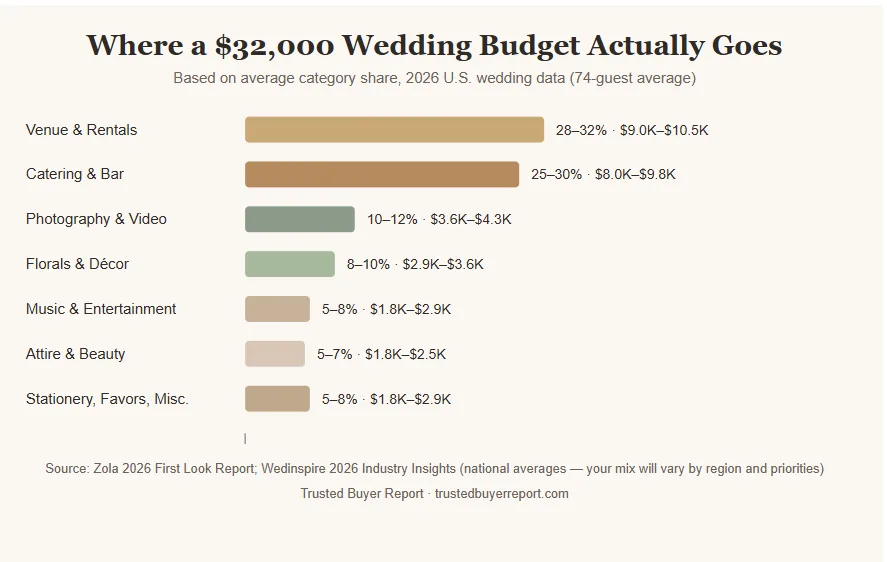
One timing detail worth flagging here: vendor prices typically rise every January. Saint Patrick Palace's 2026 planning guide notes that waiting until mid-year to book core vendors can add 5–10% to package costs — $1,500–$3,000 in avoidable spending on a $32,000 budget. Funding source matters too: per Zola's 2026 Wedding Spend Survey, couples covering the full cost themselves tend to hold tighter, firmer budget ceilings than those receiving family contributions.
Does the Day of the Week Really Change Wedding Costs?
Yes — Sunday weddings typically cost 20–30% less than Saturday weddings at the same venue tier, and the gap compounds once you factor in month and season.
Your wedding date functions as a pricing signal, not just a calendar entry. Demand is heavily concentrated: according to Wedding Statistics & Facts USA 2026, October alone accounts for 17% of all U.S. weddings, followed by September (15%) and June (12%) — meaning 41% of weddings happen in just three months. January and February, by contrast, each account for only 2%.
Day of the week compounds this effect. Saturday remains dominant, but Sunday dates run 20–30% cheaper at comparable venues, and Friday-evening weddings are gaining ground in urban markets where most guests are local. QC Event Planning's 2026 trends report notes weekday weddings are rising specifically because of better venue availability — a trend especially suited to smaller guest lists.
Concrete example: a couple shifts from a Saturday in September to a Sunday in November at the same venue. The venue fee drops 22%, their photographer cuts $800 off a peak-season Saturday rate, and catering offers an off-peak discount. Combined savings: over $2,800, with no drop in celebration quality.
How Much Can Location Save You on a Wedding?

Where you marry affects what you pay more than almost any other single decision. Coastal and major-metro venues carry premium pricing not because they're inherently better, but because local vendor day rates and regional cost of living run higher across the board. Per Wedding Statistics USA 2026, couples can save 60–70% by choosing less densely populated states or rural regions while keeping comparable quality.
A 75-person wedding in the New York metro area might run $18,000–$22,000 for venue and catering alone. The same guest count and food quality at a comparable rural Mid-Atlantic or Midwest venue might cost $8,000–$12,000 for the same two categories — a difference that comes from geography, not from compromising on the day itself.
If you're planning a destination wedding, logistics need to start earlier. According to The Vintage Saga's 2026 planning checklist, travel logistics, hotel blocks, and guest transportation should be mapped out in the 6–7 month window — extend that to 8–9 months for destination events, since waiting until the 3–4 month mark tends to produce guest confusion, accommodation shortages, and a softer RSVP rate. If you're weighing where guests should stay, our Airbnb vs. VRBO vs. Hotels comparison breaks down which option actually costs less for group blocks, and our travel insurance guide is worth a look if guests are flying internationally.
One overlooked dynamic: competition for desirable rural and coastal venues isn't purely local. As Saint Patrick Palace's 2026 guide notes, couples from major cities actively seek out regional venues to escape both winter weather and metro pricing — so a venue in coastal Florida or the Carolinas may be fielding inquiries from multiple time zones. Booking early secures availability against a wider competitive field than most couples expect.
The 12-Month Wedding Planning Timeline
Wedding planning stress is mostly a sequencing problem — couples aren't short on information, they're overwhelmed by decisions arriving in the wrong order. Here's the structure that resolves it:
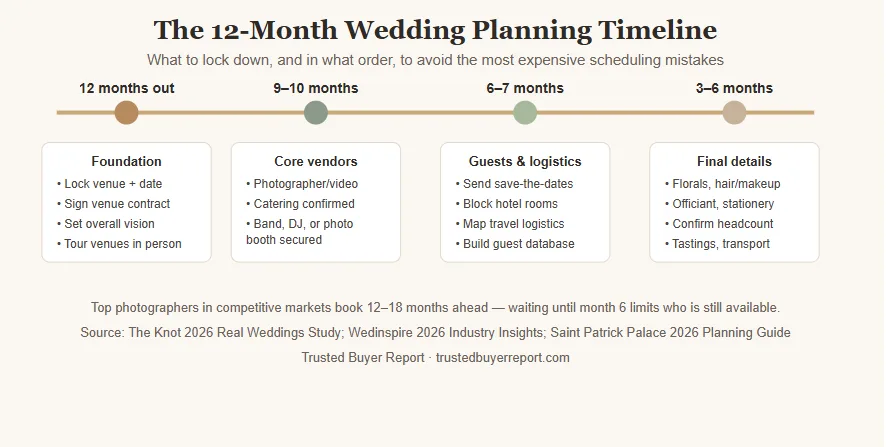
12 months out — Foundation. Venue, date, and overall vision get locked before any vendor outreach starts. As Saint Patrick Palace puts it bluntly: you don't have a wedding date until you have a countersigned venue contract — verbal holds don't count. Tour venues in person; photos don't show you acoustics, parking, or how the light looks at your actual ceremony time.
9–10 months out — Core vendors. Photographer, videographer, catering confirmation, and entertainment (band, DJ, or photo booth) get secured here. Top photographers in competitive markets book 12–18 months out — waiting until month 6 means choosing from whoever's still available, which is a quality constraint, not just a scheduling inconvenience.
6–7 months out — Guests and logistics. Save-the-dates go out, hotel blocks get reserved, travel logistics get mapped, and a structured guest database (contact info, travel plans, accommodation) gets built. Destination weddings should extend this window to 8–9 months.
3–6 months out — Details and day-of logistics. Florals, hair and makeup, officiant, stationery, and favors typically have low availability risk in this range. Final headcount confirmation drives catering minimums and seating. Menu tastings, rehearsal dinner planning, and transportation get finalized.
Wedinspire's 2026 data shows 17% of venue inquiries come from couples planning in a compressed 7–12 month window — so a tighter timeline is workable, but it demands faster decision-making from both you and your vendors.
How Much Does Adding Guests Really Cost?
Every guest you add isn't just one more seat — it's a compounding line item across catering, stationery, favors, seating, and often accommodation logistics. The math is direct: at a $120 per-head catering rate, 20 extra guests cost $2,400 before you even add table rentals, centerpieces, and place settings.
The average 2026 wedding hosts 74 guests, per Wedinspire — reflecting a real shift toward smaller, more intentional celebrations. The Knot's 2026 Real Weddings Study backs this up: as Gen Z reaches peak marrying age, large "cookie-cutter" weddings are giving way to more personalized events that prioritize connection over headcount.
A practical way to audit your list: sort every name into three tiers.
- Must-invite — immediate family and closest friends, people whose absence would change the meaning of the day.
- Would-love-to-invite — extended family, close colleagues, regular friends who matter but aren't essential to the day itself.
- Obligatory — invitations driven by social expectation rather than genuine closeness. This is where most painless cuts happen.
A couple trimming their list from 110 to 65 guests at $140 per head saves $6,400 on food and beverage alone — money that can fund a meaningfully better photographer, an upgraded menu, or a second day of celebration.
What Order Should You Book Wedding Vendors In?
Booking order isn't arbitrary — it reflects real operational dependencies, and booking out of sequence creates conflicts that are expensive (and sometimes impossible) to undo.
- Venue — sets the date, capacity, catering rules, décor limits, noise curfews, and sometimes a required vendor list.
- Photographer and videographer — book right after the venue; this category has the tightest availability of any vendor.
- Catering — follows directly from venue choice, since many venues require in-house catering or a pre-approved list.
- Music and entertainment — secure bands, DJs, and photo booths in the 9–10 month window before popular dates fill up.
- Florals, hair and makeup, officiant — generally available at 6–9 months out with low risk.
- Stationery, favors, day-of coordination — finalized in the last 3–6 months once headcount is locked.
A common, costly mistake: booking a band before the venue is confirmed, then learning the venue has an exclusive vendor list or a noise ordinance banning amplified music past 9 p.m. Band deposits are typically non-refundable. Review every vendor contract before signing for cancellation terms, postponement clauses, and force majeure language.
If your budget supports it, a day-of coordinator or full planner is a category where the cost reliably pays for itself in avoided mistakes — particularly for couples coordinating multiple vendors across a multi-stage event.
Which 2026 Wedding Trends Are Worth the Money?
Not every trend deserves a line in your budget. The useful filter is one question: does this serve your actual vision and guest experience, or does it just add cost to meet an outside expectation?
Multi-day celebrations are a genuine growth trend, per QC Event Planning's 2026 report — spreading events Friday through Sunday creates a more relaxed pace and gives guests time to connect beyond the ceremony. A typical structure: Friday welcome dinner, Saturday ceremony and reception, Sunday casual brunch. The incremental cost — roughly $40–$65 per head for a Friday dinner and $25–$40 per head for Sunday brunch — adds $3,000–$7,500 to a 75-person budget. It pays off when most guests are traveling in; for a mostly local guest list, the extra spend is harder to justify.
Non-traditional reception formats (cocktail-style, lounge seating, food stations over plated dinners) are trending for the same reason: they reduce certain fixed costs while increasing guest interaction — though they require clear communication on your invitations so guests know what to expect.
FAQ: Wedding Budgeting in 2026
Is $32,000 a realistic wedding budget for 2026? It's the U.S. average, but it spans a huge range of guest counts and styles. Build your number from your actual guest list, region, and priorities rather than treating $32,000 as a target.
What's the single biggest lever for cutting wedding costs? Date selection. Moving to a Sunday, an off-peak month (January, February, March, or December), or a less-saturated region can each independently cut costs by 20% or more — and the savings stack when combined.
Should I book vendors before or after confirming the venue? Always after. The venue determines your date, catering rules, and sometimes an approved vendor list — booking entertainment or catering first risks a non-refundable deposit on a vendor your venue won't allow.
How many months out should I start planning? 12 months gives you full access to top-tier photographers and popular venues. A 7–12 month timeline is workable for roughly 17% of couples, per Wedinspire, but requires faster decisions and less room for vendor availability conflicts.
Does cutting the guest list actually save meaningful money? Yes — it's one of the highest-leverage cuts available. Removing 20 guests at a $120–$140 per-head catering rate alone saves $2,400–$2,800, before stationery, favors, and seating costs.
This article was researched and drafted with AI assistance, then reviewed and fact-checked by a human editor before publishing. Grounded Pick's guides are research-based — we synthesize verified industry data and cite our sources; we don't accept payment for rankings. Read our methodology · How we use AI
Affiliate Disclosure: Grounded Pick may earn a commission when you click links or make purchases through our site, at no extra cost to you. Full disclosure.
Discussion
No comments yet. Be the first to share your thoughts.